 malice
2c46c9104d
malice
2c46c9104d* feat(region-routing): P1 tagging + region_routes primitive + read/write API + preview launcher - config.py: add Coverage.region_tagging (bool=False); add RegionRouteMatrix dataclass (enabled, cells) above NotificationsConfig; add region_routes field to NotificationsConfig; add explicit hydration branch for region_routes in _dict_to_dataclass mirroring destinations pattern. - coverage_area.py: add MonitoringArea.name (str|None=None, frozen); update areas_from_config to preserve name; refactor inline geom extraction from classify_event_areas into shared _event_geom_json helper; add matching_area_names(geom_json, areas)->list[str] (additive, all named matches, config-order, deduped; gate unchanged); add event_region_names convenience wrapper. - coverage_filter.py: add region_tagging ctor kwarg; stamp event.region/ regions before the gate when region_tagging=True and areas non-empty and not event.regions (never clobbers satpass preset). - pipeline/__init__.py: wire region_tagging into CoverageFilter construction. - notification_routes.py: add GET /notifications/regions (named coverage area names, config-order, deduped); GET /notifications/region-routing (matrix as JSON); POST /notifications/region-routing (explicit RMW — only region_routes changes, toggles/rules/destinations survive). - scripts/preview_dashboard.py: mesh-free launcher — dashboard API only, no mesh connector, no broadcast loop; vite runs separately. All 87 coverage tests pass; 300 total pass; 6 pre-existing failures unchanged (adapter config count mismatch + MeshCore EventType.NEW_CONTACT). * feat(region-routing): manual region x family matrix editor page Adds RegionRoutingMatrix.tsx — a plain editor over the region_routes config primitive. Rows = families (via useFamilies()), cols = regions (from GET /api/notifications/regions). Each cell exposes MT channel (ChannelPicker single + includeDisabled), MC channel name (text input), min_severity select (routine/priority/critical/immediate), and an enabled checkbox. Only cells where MT or MC is set are included in the sparse POST payload. Master enable toggle maps to top-level enabled. MT budget guard warns when more than 7 distinct MT indices are in use. Sticky family column; horizontal scroll for wide region sets. Registers route /region-routing in App.tsx and adds "Region Routing" nav entry (Map icon) under the Meshtastic section in Layout.tsx, immediately after Routing. Co-Authored-By: Claude Sonnet 4.6 <noreply@anthropic.com> * fix(region-routing): regions endpoint reads saved (disk) coverage so routing columns are dynamic without a bot restart; preview reloads config after writes * feat(routing): unify MT/MC routing into per-family cards; region routing as an in-card expand; remove rules/destinations UI + standalone page * refactor(routing): move Meshtastic Routing from /notifications to /meshtastic/routing (mirror /meshcore/routing); redirect legacy path * feat(region-routing): dispatcher honors region_routes matrix (authoritative-on-match, per-region cooldown, per-channel dedup); non-matrix path unchanged Co-Authored-By: Claude Opus 4.8 (1M context) <noreply@anthropic.com> * fix(region-routing): matrix dedup key must match boot-restore 2-tuple form (prevents restart re-broadcast flood); regression test --------- Co-authored-by: Matt Johnson <mj@k7zvx.com> Co-authored-by: Claude Sonnet 4.6 <noreply@anthropic.com> |
||
|---|---|---|
| .. | ||
| src | ||
| LICENSE | ||
| package.json | ||
| README.md | ||
d3-polygon
This module provides a few basic geometric operations for two-dimensional polygons. Each polygon is represented as an array of two-element arrays [[x1, y1], [x2, y2], …], and may either be closed (wherein the first and last point are the same) or open (wherein they are not). Typically polygons are in counterclockwise order, assuming a coordinate system where the origin ⟨0,0⟩ is in the top-left corner.
Installing
If you use npm, npm install d3-polygon. You can also download the latest release on GitHub. For vanilla HTML in modern browsers, import d3-polygon from Skypack:
<script type="module">

import {polygonHull} from "https://cdn.skypack.dev/d3-polygon@3";

const hull = polygonHull(points);

</script>
For legacy environments, you can load d3-polygon’s UMD bundle from an npm-based CDN such as jsDelivr; a d3 global is exported:
<script src="https://cdn.jsdelivr.net/npm/d3-polygon@3"></script>
<script>

const hull = d3.polygonHull(points);

</script>
API Reference
Returns the signed area of the specified polygon. If the vertices of the polygon are in counterclockwise order (assuming a coordinate system where the origin ⟨0,0⟩ is in the top-left corner), the returned area is positive; otherwise it is negative, or zero.
# d3.polygonCentroid(polygon) <>
Returns the centroid of the specified polygon.
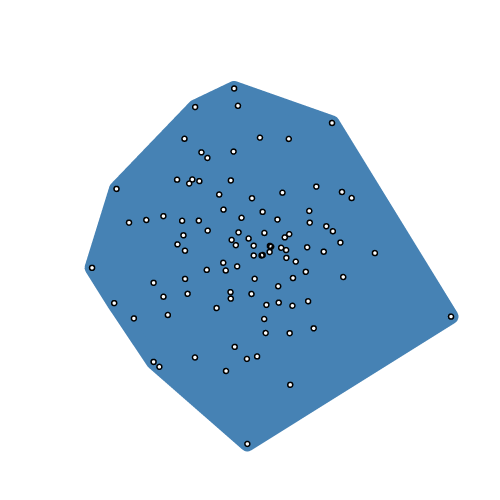
Returns the convex hull of the specified points using Andrew’s monotone chain algorithm. The returned hull is represented as an array containing a subset of the input points arranged in counterclockwise order. Returns null if points has fewer than three elements.
# d3.polygonContains(polygon, point) <>
Returns true if and only if the specified point is inside the specified polygon.
# d3.polygonLength(polygon) <>
Returns the length of the perimeter of the specified polygon.